Dublin residents report wearing headphones in up to half of public interactions
Experts warn that constant audio consumption is altering how people process daily life and increasing the risk of hearing loss.
By John Price ·
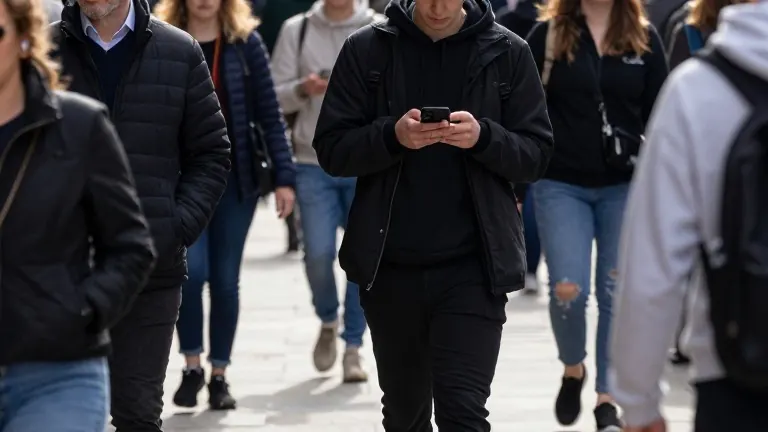
For many Dubliners, silence has become a rare commodity in the city center. During a busy lunch hour on Dawson Street, observers noted that roughly one in two pedestrians wore headphones. This shift changes how people interact with their immediate environment, often replacing direct observation with a curated audio stream. The habit is so prevalent that it now extends to moments where audio seems unnecessary, such as short trips to a restroom or while waiting for public transit.
The numbers paint a clear picture of daily habits. Laoise Lopez, a 21-year-old history student at Trinity College Dublin, admits to wearing earphones without playing music. She describes the behavior as a way to appear busy. Her friend Clara Rogers agrees, noting that younger generations use devices more frequently than older ones. Rogers explained that she puts on headphones for even a three-minute walk to the library bathroom to create a personal break. She described this as a distraction from the awkwardness of walking alone.
Caitlin Evoy, a member of the same group, wears earphones every day during commutes and study sessions. She acknowledges that the practice reduces human interaction and awareness of surroundings. This trend is not limited to students. Cian McElligott, a 21-year-old engineering student at Trinity, is making a conscious effort to reduce his usage. He now removes his headphones when entering shops or coffee shops, a behavior he did not adopt previously. He recalled serving a customer in a pub who kept their headphones on while waiting for a coffee, an action he now finds rude.
Experts argue that this constant audio input has psychological and physical consequences. Sarah Cassidy, president of the Psychological Society of Ireland and a psychologist with over 25 years of experience, says that filling silence with sound keeps people on autopilot. She states that individuals are not actively participating in their own lives because external content curates every experience. Cassidy warns that this leads to a loss of ability to think, reason, and process emotions. She notes that while music can be helpful in specific moments, the current rate of use is unsustainable. She describes the lack of unfilled time as a real loss for modern young people and a potential factor in long-term mental health issues.
Physical risks are also rising. Prof. Conor Deasy, a consultant in emergency medicine and clinical director at Cork University Hospital, points out a lack of research regarding headphone use in serious injuries. He suggests that paramedics should document whether victims of vehicle collisions were wearing headphones. Deasy notes that hearing is a vital sense for safety. He argues that while the risk may be low in safe environments, it becomes a significant disadvantage when sharing roads with motorized vehicles. He believes that if research quantifies this risk, it could lead to regulations for cyclists and e-scooter users.
Hearing damage is the most immediate concern. The World Health Organization states that more than one billion young people aged 12 to 35 face a risk of permanent hearing loss from loud recreational sounds. Dolores Madden, an audiologist and marketing director at Hidden Hearing, says she is seeing more cases of noise-induced hearing loss. She attributes this to the consistency of loud levels. Madden advises limiting headphone use to 60 percent of maximum volume for 60 minutes a day. She warns that continued exposure to noise levels above 60 decibels, the volume of a typical conversation, will cause issues down the road. Inner-ear earphones pose a greater risk because they place sound closer to the eardrum.
The habit of listening to content to fall asleep is another area of concern. Cassidy says this prevents the mind and body from drifting off naturally, which is necessary to consolidate memory and learning. She points to strong correlations between poor sleep and cognitive decline, including Alzheimer's disease. As the habit becomes embedded in daily routines, the long-term effects on physical and mental health remain a growing area of study.
Source: The Irish Times