Currach Racing: Three men, nine titles, and a fading tradition
Micheál Ó Maoilchiaráin and his crew maintain a 100-year-old sport in Connemara, where depopulation threatens the community.
By Julian Khan ·
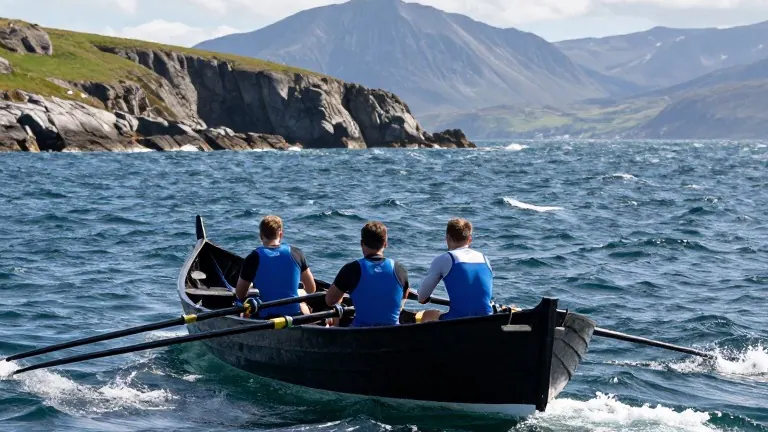
Three men row a 25-foot boat on the Atlantic Ocean near Ros Muc, County Galway. The crew, led by Micheál Ó Maoilchiaráin, has won nine All-Ireland titles in currach racing. The sport is conducted entirely in the Irish language, a requirement that distinguishes it from other national competitions.
Ó Maoilchiaráin, 34, rows in the stern position. He sets the stroke rate for his teammates, Máirtín Ó Maoilchiaráin in the middle and Joe Rua Seoighe in the bow. The trio has raced together for 10 years. Their boats are built specifically for speed, measuring 25 feet in length compared to the standard 23-foot currach used for transport. Local builders refine the design with each new vessel to gain marginal speed advantages.
Races cover a triangular course of two or three miles. Each event lasts between 14 and 15 minutes. The final round features four boats selected by lot. The physical demand is intense, with the crew relying on minimal communication to maintain rhythm. Instructions are often reduced to the single word tarraing, meaning pull, when the team is under pressure.
The sport originated informally around 1920 during local patron days. It was formalized in 1953 as part of the An Tóstal heritage festival. At its peak popularity, 80,000 spectators gathered on the seafront at Salthill to watch the events. Historic families, including the Seoighe and Ó Cualáin clans, established dominance in the early decades. The tradition now extends to crews in Kerry and Donegal, as well as diaspora groups in Boston.
Ó Maoilchiaráin works as a director of professional Irish programmes at Maynooth University. He is completing a PhD in Irish and sean-nós singing. He lives in a region facing demographic challenges, with shuttered factories and closed businesses visible along the coast. He acknowledges that fewer native speakers remain in the Gaeltacht area than in previous generations.
The crew continues to pass the tradition to the next generation. Máirtín Ó Maoilchiaráin’s 16-year-old son has begun training with the team. Most competitors are related by blood, reinforcing the familial nature of the sport. Ó Maoilchiaráin recently taught workshops on currach building at a traditional boat festival in Verona, Italy. He is also launching a podcast called Cé Tú Féin to document local dialects and stories.
The three men have maintained their competitive edge while navigating the changing landscape of south Connemara. Their success relies on a blend of modern training and ancestral knowledge. The sport remains a regular part of summer life for the community, rather than a preserved relic.
Source: The Irish Times