30-Year-Old Forward Dies After 20-Second Wait for Medical Care on Field
Spanish police investigate the collision and emergency treatment of Jesús de Miguel, who died a day after collapsing during a second division match.
By Julian Khan ·
Team medical staff reached Tenerife forward Jesús de Miguel 20 seconds after he collapsed on the pitch during a second division match in Spain. De Miguel, 30, died Tuesday, one day after suffering a cardiac arrest following a collision with an opposing goalkeeper. The incident has triggered a police investigation and a review of the emergency protocols used on the field.
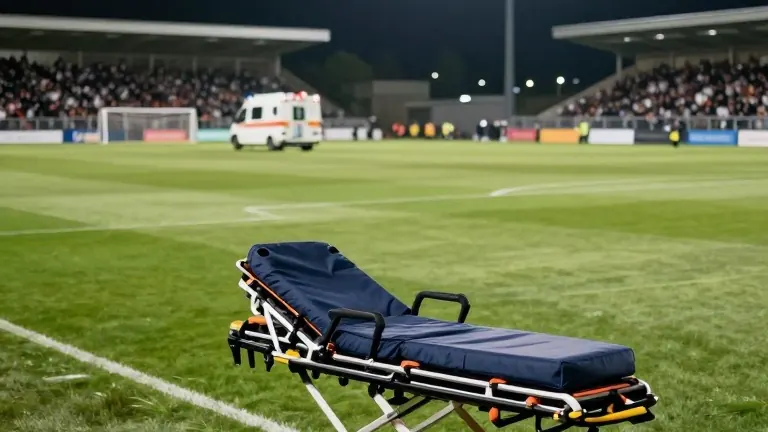
De Miguel was playing against Andorra late in the match when he was struck in mid-air by goalkeeper Jesús Owono while disputing a high ball. He fell to the ground and did not get up. Emergency workers ran a stretcher to the scene in under a minute. An ambulance waited just off the field to transport him to a hospital.
The exact sequence of medical care between his collapse and his removal from the pitch remains unclear. De Miguel lay prone on the grass for approximately five minutes before being loaded onto the stretcher. Reports conflict on whether cardiopulmonary resuscitation began on the field or in the ambulance. Some Spanish media outlets stated he received CPR in the ambulance and regained a pulse. Others reported the procedure started on the pitch. It is not yet known if a defibrillator was used during that window.
Elvira González, president of Spain’s Association of Nurses, Emergency Medics and Caregivers, said her group is seeking specific details. She told the Associated Press that the organization wants to know where and when De Miguel supposedly regained a pulse. González emphasized that international standards require CPR to start from the first minute and that a defibrillator is essential for survival. She noted that a patient should only be moved once a pulse is restored.
Spain’s National Police have opened a file for possible involuntary manslaughter, a standard procedure for non-natural deaths. Investigators will determine if Owono’s challenge went beyond the normal course of play. Local media reports suggest the probe may also examine the immediate medical treatment provided at the stadium. Police in Madrid and Tenerife have not commented on the scope of the investigation.
Rayco García, the largest shareholder of Tenerife, said the medical team followed protocol and arrived on the field quickly. He acknowledged that the club is waiting for an autopsy to determine the cause of death. García said some observers believe the impact caused the death, while others think the team stabilized the player artificially. He said he wants the investigation to reveal if any actions within the club's control could have prevented the tragedy.
García explained that the club’s medical service did not order the ambulance to enter the field to assist with evacuation. Spanish soccer federation regulations require the home team to have at least one doctor on site. The home club must also have an ambulance equipped with life support, including a defibrillator, ready at the stadium. La Liga did not respond to requests for comment regarding these emergency protocols.
Owono issued a statement through his club on Wednesday. He described the days as the most difficult of his life. He expressed immense pain over the loss of De Miguel and said he would face the upcoming matters with respect. De Miguel’s wife and 1-year-old daughter were present at the game. His parents flew from the mainland to Tenerife, which is part of the Canary Islands archipelago.
Tenerife will travel to the central province of Toledo for De Miguel’s funeral. García said the service is tentatively scheduled for Thursday. Fans left flowers at a makeshift shrine outside the stadium. Teams across Europe paid tribute to the forward before their Champions League matches on Tuesday.
Source: ClickOnDetroit WDIV