Palatine police say jammed gun stopped planned Hindu temple shooting
A 19-year-old college student was charged with felonies after police found an AR-style rifle and 300 rounds of ammunition in his apartment following an aborted attack at an Aurora temple.
By Claire Herrera ·
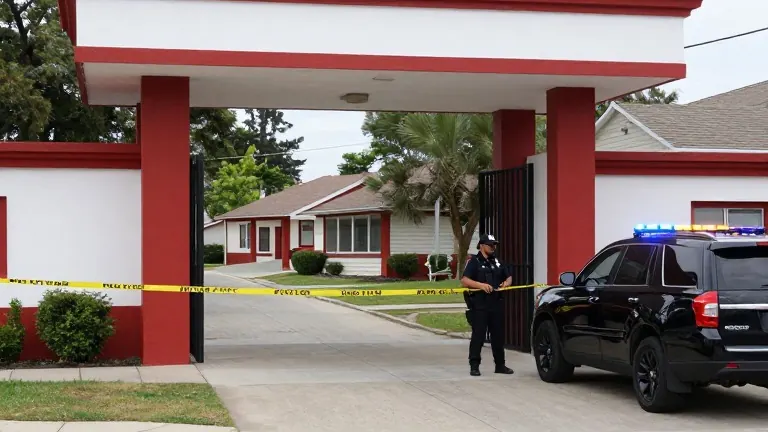
Police in Palatine, Illinois, announced on October 11 that Alexandros Paporakis attempted to start a mass shooting at the Sri Venkateswara Swami Temple in Aurora, Illinois. The temple is located roughly 40 miles west of Chicago. Authorities stated that a malfunction in the weapon prevented the attack from continuing.
Paporakis, a 19-year-old college student and Taco Bell cashier, faces two felony charges: making a terrorist threat and unlawful possession of a rifle. A Cook County assistant state attorney filed an affidavit stating that coworkers reported the incident. One coworker spoke by phone with Paporakis immediately after the attempted attack. That same coworker received an eight-page document from Paporakis outlining his motivation for the plot.
Police searched Paporakis’ apartment later that day and found a bag containing an AR-style rifle. The bag also held 300 rounds of ammunition, eight loaded magazines, one loaded extended magazine, and body armor. Officers recovered a gas can and items displaying Nazi symbols and anti-Indian slurs. Palatine Police Chief William Nord said at a press conference that the seriousness of the threat cannot be overstated.
Court filings describe the eight-page document as filled with derogatory and racially charged slurs directed at people of Indian ancestry, Jews, and African Americans. The document referred to these groups as subhumans. It indicates that Paporakis selected the temple location two months before the incident but had planned an attack for two years. In the writings, Paporakis described himself as a sociopathic white supremacist neo-Nazi filled with hatred and fantasizing about mass murder nearly every day.
The date of the attempted attack coincided with the start of a major nine-day Hindu festival. U.S. Congressman Raja Krishnamoorthi, a Democrat from Illinois, attended the event with his family. Krishnamoorthi has asked the FBI to investigate the incident as a federal hate crime.
Rohit Chopra, a communications professor at Santa Clara University and visiting fellow at the Center for South Asia at Stanford University, said an attack of this scale has not previously been directed at South Asians. He noted that online and political discourse over the last four years has shifted to depict Indian Americans and other South Asians in conspiracist and dehumanizing ways. Chopra attributed this change to growing anti-immigrant populism, economic anxiety, and rising political visibility.
Prasiddha Sudhakar, a board member of the Network Contagion Research Institute, said toxic online rhetoric has moved from fringe platforms to mainstream ones. She coauthored reports for the NCRI that documented this shift. Sudhakar said the community is vulnerable because it lacks organized political power despite high median incomes and visible professional success. She noted that two-thirds of the Indian population in the U.S. are immigrants, and nearly half of those are not naturalized citizens.
Research co-authored by Chopra for the Center for the Study of Organized Hate found that anti-South Asian hate speech on the social media platform X was 240% higher between January 2025 and June 2026 than it was in January 2024. Chopra said the H-1B visa issue has become a political focal point, with Indian nationals accounting for more than 70% of such visas. Each time a political figure made a remark about H-1B visas, online hate on X increased.
Sudhakar traced the origins of the rhetoric to fringe spaces like 4chan and Gab around 2022. The narratives often graft antisemitic conspiracy theories onto a new group, using terms like the Brahmin Organized Government. She said these spikes in online hate coincided with the public prominence of figures such as Parag Agarwal, Sriram Krishnan, and Usha Vance. The Department of Homeland Security recently removed a post featuring a Sikh man and the caption, Get off our roads, you don't know how to drive Mr. Singh, after public backlash.
Pushpita Prasad of the Coalition of Hindus of North America said organizing is difficult because Hindu temples do not function like congregations in other religions. Members do not belong to specific temples, which makes sharing information harder. Prasad said many well-off Hindus remain in immigration limbo, which prevents them from speaking out as loudly as other communities might.
Source: WVXU