Tesla’s Robot Delivery Date Slips Again, Citing Hand and AI Hurdles
The company has pushed the launch of its Optimus humanoid to late 2027, acknowledging that the robot’s dexterity and artificial intelligence are not yet ready for widespread industrial use.
By John Price ·
The central tension in the race to build useful humanoid robots is no longer just about who can make a machine stand up, but who can make it work reliably in a real-world setting. On the recent Q3 2026 earnings call, Tesla’s leadership confirmed that deliveries of the Optimus robot to outside customers are now targeted for the end of 2027. This shift comes with a candid admission that the robot’s hands, its overall durability, and its artificial intelligence require significant refinement before it can handle the demands of industrial jobs.
This delay follows a pattern of shifting timelines that has defined the development of the Optimus project. In 2024, the plan was for internal use in 2025, with high-volume production for other companies in 2026. By January 2025, the goal was to build roughly 10,000 units, with several thousand performing useful work by year’s end. That target did not materialize, leading to the current projection that external deliveries will not begin until late next year.
Tesla has begun early production of the robot on its high-volume line in Fremont, California, a facility previously used for the Model S and Model X. While the line is designed for a theoretical capacity of one million robots per year, or about 20,000 units a week, executives noted that reaching this speed will take at least a year due to ongoing design changes. The company describes the units coming off the line this quarter as the first to be of production quality, implying that earlier prototypes were not ready for industrial standards.
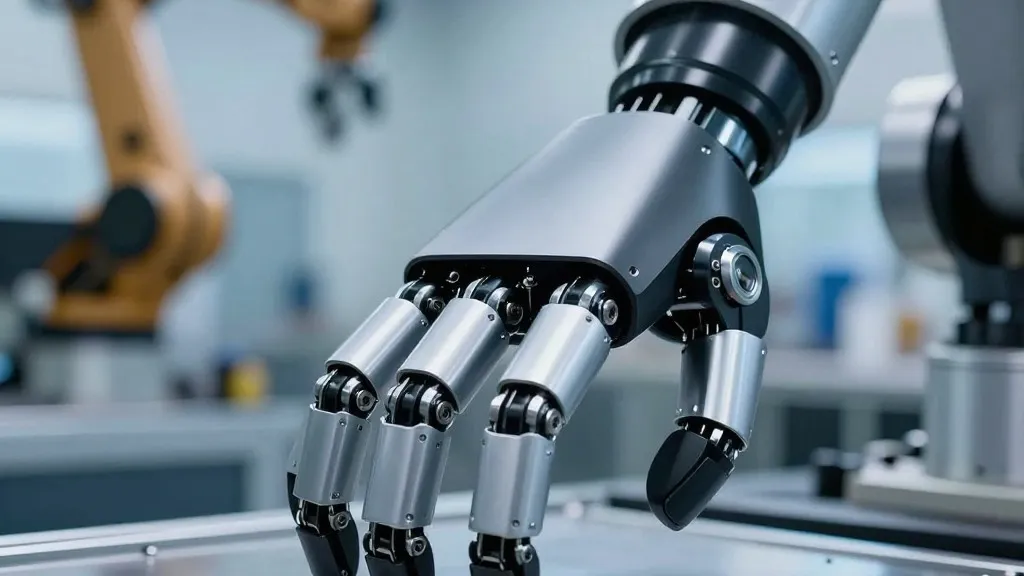
The specific hurdles cited by Tesla engineers focus on the electromechanical design, particularly the hand. The fingers must be soft enough to handle delicate objects yet durable enough to withstand constant wear, a challenge compounded by the fact that robots cannot heal like human skin. Additionally, custom gears present reliability concerns. On the software side, Tesla is working through issues with its AI architecture. Unlike its cars, which have a massive fleet collecting data for Full Self-Driving, Tesla does not yet have a large fleet of robots. To solve this, the company plans to build between 10,000 and 20,000 robots to practice tasks in an internal facility known as the Optimus Academy.
Tesla also intends to integrate its AI5 chip into the Optimus platform around April 2027. To prove the robot’s capabilities, leadership promised a video within the next month or two showing the machine performing tasks that are not pre-programmed. This move is a response to criticism that many humanoid demonstrations are merely scripted routines that would fail in unstructured environments.
Competitors are also facing similar challenges, though they appear to be on comparable or slightly more advanced schedules. XPeng recently activated an automated production line for its IRON robot in Guangzhou, with mass production planned for the end of 2026 and deliveries starting in the first half of 2027. Meanwhile, Boston Dynamics began producing its electric Atlas robot in January, with all 2026 deployments already committed to clients like Google DeepMind. Boston Dynamics has taken a pragmatic approach to the hand problem, prioritizing sturdy grippers for industrial parts over human-like dexterity.
Despite these developments, Tesla’s leadership maintains that no competitor is close to their progress on a general-purpose humanoid. However, the public record shows that rivals are already deploying robots in specific settings, such as car factories, while Tesla is still refining its technology for broader application. The core issue remains generalization: the ability of a robot to handle new tasks it was not specifically trained for. Until that is solved, the robots remain impressive demonstrations rather than essential infrastructure.
For now, the focus shifts to the coming months to see if Tesla’s promised video delivers on its promise of unscripted work. If the robot can demonstrate genuine adaptability, the late 2027 timeline may hold. If not, the timeline may slip again, as it has every year since the project’s inception. The industry is watching closely to see if building the robot was indeed the easy part, or if making it useful is the true barrier to entry.
Source: Electrek · original report published