Governor races hinge on 18-18 split as 19 open seats reshape map
With Democrats needing just two seats to end a 16-year Republican majority in the governorships, voters face a complex mix of open contests and high-profile matchups.
By John Price ·
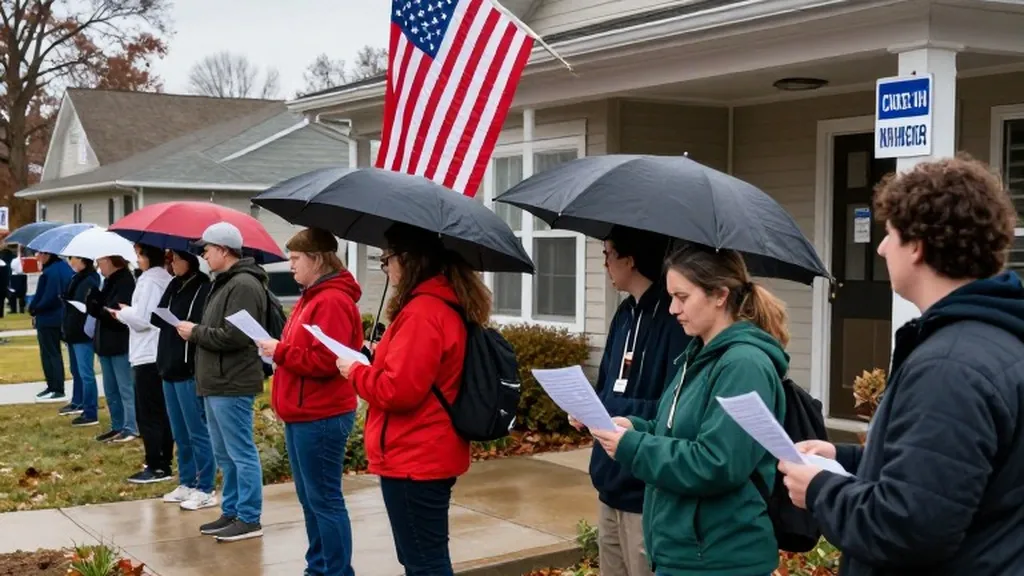
Voters across the nation are casting ballots today in a midterm election that defines the balance of power for the final two years of President Donald Trump's second term. While the House and Senate races draw intense scrutiny, the governor's offices represent a distinct battleground where the stakes are equally high for both parties. Heading into this cycle, Republicans held 26 governor's offices and Democrats held 24. Of the 36 governorships on the ballot, each party holds exactly 18, creating a perfectly balanced starting point that makes every single race a potential turning point for national control.
The structure of these 36 races is heavily influenced by the number of open seats. Nineteen of these contests lack an incumbent on the ballot, a factor that often shifts voter attention toward new candidates and national issues rather than personal records. Fifteen governors are term-limited and cannot run again. Additionally, three sitting governors chose not to seek re-election. Iowa's Kim Reynolds, Minnesota's Tim Walz, and Wisconsin's Tony Evers have all decided to move on. Rhode Island's Daniel McKee lost his primary, adding to the list of open seats that will determine the next wave of state leadership.
Democrats require a net gain of two governorships to achieve a nationwide majority, a feat they have not accomplished since 2010. This mathematical threshold places immense pressure on the party to perform well in competitive states. Republicans, meanwhile, must hold their ground in states that lean Democratic to prevent a historic shift in executive power. The outcome of these races will directly influence policy implementation at the state level, particularly in areas such as border security and economic regulation, which are central to the current political discourse.
Nine specific governor races are identified as key battlegrounds according to Ballotpedia. These states include Alaska, Arizona, Georgia, Iowa, Kansas, Michigan, Nevada, Ohio, and Wisconsin. The diversity of these locations reflects the geographic spread of the competition. In some of these states, the races are tightly contested due to the recent redistricting efforts and the national mood regarding the economy. The Associated Press notes that voters are struggling with high prices, a sentiment that is likely to impact turnout and voting patterns in these critical contests.
Specific matchups in these battlegrounds highlight the high stakes involved. In Georgia, Republican health care executive Rick Jackson faces Democratic former Atlanta Mayor Keisha Lance Bottoms. This race is significant because Brian Kemp, the current governor, is term-limited. In Nevada, Republican Gov. Joe Lombardo is challenging Democratic Attorney General Aaron Ford. In Ohio, Republican Vivek Ramaswamy is running against Democrat Amy Acton. Ramaswamy's campaign recently faced attention for an ad featuring Acton's estranged mother, a detail that has drawn media interest to the campaign dynamics in this pivotal state.
Democrats are defending five governorships in states that President Trump won in 2024. These states are Arizona, Kansas, Michigan, Pennsylvania, and Wisconsin. Holding these seats would demonstrate the party's ability to retain power in Republican-leaning territories. Conversely, Republicans are defending two governorships in states that Kamala Harris won in 2024. New Hampshire and Vermont represent these challenges for the Republican party. The ability to hold these seats in Democratic-leaning states will be a key indicator of the party's strength in the 2028 cycle.
The Associated Press describes the broader election as a referendum on the president's second term, with many voters expressing anger over an unpopular war with Iran and high consumer prices. AP-NORC polling indicates that 35% of U.S. adults approve of Trump's job performance. This approval rating is one factor among many that voters are considering as they head to the polls. The polls are currently open, and no results have been declared, leaving the final outcome of these 36 races to be determined by voter behavior today.
Money plays a significant role in these races, as the 2026 elections are likely to be the most expensive in history. Republican committees have outraised and outspent Democratic committees, aided by Trump-affiliated groups and Elon Musk. However, at the candidate level, Democrats have outraised their opponents. This funding disparity creates a complex landscape where national money may not always translate into local victories. The allocation of ad spending is also a point of analysis, with 88.1% of Republican general election TV ad spending directed to states and districts that Trump won in 2024.
Voter turnout remains a critical variable. RNC Chairman Joe Gruters stated that everything depends on turnout, emphasizing the importance of mobilizing the base. Conversely, DCCC Chair Rep. Suzan DelBene suggested that the American people are angry and want change. These contrasting narratives frame the day's events. With more than 57 million people having already voted as of Monday, the early vote has surpassed the levels seen in the 2022 election in many closely watched states. This high level of early participation suggests that the final tally will be determined by the remaining voters heading to the polls today.
The administration of these elections has also been a topic of discussion. A federal judge temporarily barred the Trump administration from carrying out a plan to prevent noncitizen voting, a move that critics said could risk disenfranchising eligible voters. The U.S. Postal Service has added hours and staff to ensure that mail ballots are counted on time. These logistical efforts are crucial for ensuring that the will of the people is accurately reflected in the final results of the 36 governor races.
As polls close in various states, the focus shifts to the counting process. The results will determine who controls the statehouses for the next four years. For Republicans, holding their 18 seats is essential to maintaining the status quo. For Democrats, winning two additional seats would mark a significant victory. The 19 open seats add an element of uncertainty, as voters are not voting on incumbents but on the direction of the country. The final numbers will emerge in the coming days, but today's votes are the foundation for the next phase of American politics.